

(This article was last updated on October 7, 2026.)
If you’re self-employed and use part of your home for business, you may be able to claim the home office deduction. This deduction allows eligible business owners to deduct certain expenses associated with the portion of their home used for business.
Keep in mind that simply working from home doesn’t automatically qualify you. This article covers what you need to know about who can claim the home office deduction, which expenses may qualify, and how to calculate it.
Find out what a comprehensive deduction strategy can mean for your business →
Not everyone can claim a home office deduction
Generally, to qualify for the home office deduction, you must be self-employed and use a specific area of your home regularly and exclusively for business. Your home must also generally be your principal place of business, although there are other circumstances that may qualify.
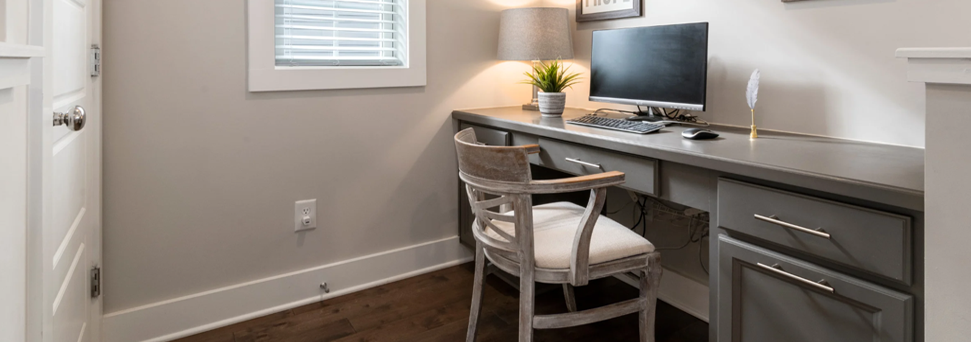
Your workspace doesn’t have to be a separate room—or even look like a traditional office. It can be a clearly identifiable portion of a room as long as that area is dedicated exclusively to qualifying business use.
For example, suppose you use part of your basement exclusively to make and ship custom woodworking projects. If that area is regularly used only for your business and you otherwise meet the IRS requirements, it may qualify for the home office deduction.
The exclusive-use requirement is important. If you work from your dining room table during the day but your family uses the same table for dinner at night, that space generally wouldn’t qualify.
There are exceptions to the exclusive-use requirement for certain daycare facilities and areas used to store inventory or product samples.
W-2 employees generally cannot claim the federal home office deduction simply because they work remotely.
Simplified vs actual expense method
Eligible taxpayers generally have two ways to calculate the home office deduction. The method that produces the larger deduction depends on your workspace, housing expenses, business income, and other factors. The rules and limitations also differ between the two methods.
Simplified method — To calculate the home office deduction for the simplified method, multiply the square footage of your office space by $5. That’s it! Is your home office 300 square feet? Great! The IRS gives a $5.00 deduction per square foot for any space that is used exclusively for business (maximum of $1,500 for a 300-square-foot space). For example, if you are using an office that is 150 square feet, with the $5.00 deduction, that amount would be $750.00. It’s that simple!
Actual expense method — With this method, you deduct the actual expense of your office. For expenses that only impact your office (such as paint, office decorations, repairs to your office, etc.) you can deduct 100%. For other expenses (such as depreciation, rent or mortgage, property taxes, home insurance, utilities, maintenance, and general repairs), you can deduct a percentage of those expenses. To calculate this percentage, divide the square footage of your office by the square footage of your home. This tells you what percentage of your home your office takes up. For example, if you have a home that is 2,000 square feet and a home office that is 200 square feet, you could deduct 10% of your utilities, rent, repairs, etc.
Keep records to support your deduction
Whichever method you use, good records are important. Keep documentation showing the size and business use of your workspace. If you’re using the actual expense method, you’ll also want records supporting the expenses included in your calculation, such as utility bills, insurance statements, repair invoices, rent payments, and other applicable expenses.
Taking a few minutes to document your home office now can make calculating and supporting your deduction much easier at tax time.
Make your home office part of your broader tax strategy
The home office deduction is just one of the deductions that may be available to a self-employed business owner. The bigger opportunity is making sure you’re identifying eligible expenses, keeping accurate records, and making tax decisions throughout the year instead of waiting until it’s time to file.
At Vyde, we combine bookkeeping, tax preparation, and year-round guidance to help small business owners understand which tax strategies may apply to their situation.
Have questions about your home office or other business deductions? Get started with Vyde and talk with our team about your business and tax situation.
Although we hope you find find the information in this article helpful, it is for informational purposes only and is neither tax nor legal advice.